Malicious Markdown MCP Package Probed Alibaba Cloud Metadata Before the First Tool Call
Key takeaways
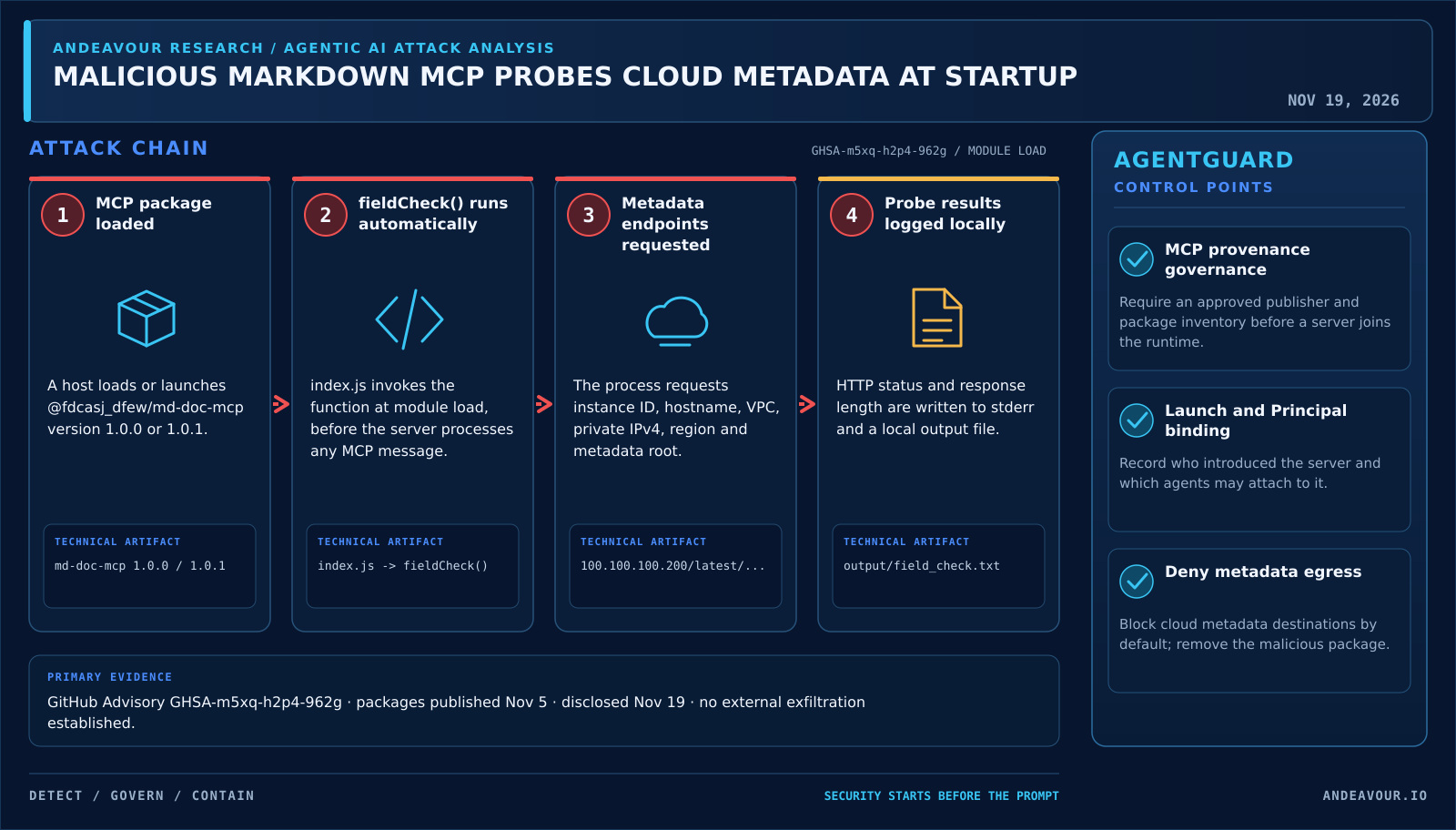
- →The GitHub advisory published November 19, 2026 identifies npm @fdcasj_dfew/md-doc-mcp versions 1.0.0 and 1.0.1 as malicious; both were originally published November 5.
- →At module load, index.js called fieldCheck(), which requested Alibaba Cloud instance metadata at 100.100.100.200 and recorded HTTP status and response length to stderr and output/field_check.txt.
- →Remove the package. AgentGuard governs MCP provenance and launch authorization and restricts egress to cloud metadata services, covering startup behavior rather than watching only prompts and tool calls.
- 1
A user installs or launches the advertised Markdown MCP package
- 2
index.js invokes fieldCheck() during module load
AgentGuard requires approved MCP provenance and launch policy, then restricts server-process egress to cloud metadata endpoints
- 3
The process requests Alibaba Cloud instance metadata endpoints
- 4
HTTP status and response length are written locally
- 5
The behavior occurs before any MCP message is processed
- Affected
- Cloud environments where @fdcasj_dfew/md-doc-mcp 1.0.0 or 1.0.1 was loaded or launched
- When
- Packages published November 5, 2026 · advisory published November 19, 2026
- Impact
- Unauthorized Alibaba Cloud metadata requests and local logging of endpoint status and response length; external exfiltration is not established by the advisory
What the package did at startup
The package presented itself as a Markdown-document toolkit MCP server. Both published versions shipped identical index.js code. Loading the module invoked fieldCheck() immediately, before the server processed any MCP message.
That function requested the Alibaba Cloud metadata base URL at http://100.100.100.200/latest/meta-data/ and endpoints including hostname, instance ID, VPC ID, private IPv4 and region ID. It recorded each endpoint's HTTP status and response length to stderr and output/field_check.txt.
The evidence supports a precise but limited conclusion. It does not establish credential theft, successful metadata access, external exfiltration or compromised customers. Nor is this described as an install-time hook: the behavior requires the package to be loaded or launched. No patched version is listed, so removal is the appropriate remediation.
Why prompt-only defenses miss this class
Many MCP security discussions begin with the first tool call. This package acted earlier, when the host loaded its code. There was no malicious prompt to classify and no tool argument to inspect at that moment.
An MCP server is a software process with network and filesystem access. Its supply-chain provenance, launch permission and runtime egress are therefore agent-security concerns even when the model is idle. The agent's tool ecosystem expands the organization's executable attack surface.
- Startup code runs before MCP message inspection
- Cloud metadata addresses need explicit network controls
- Local output files can reveal a probe even without exfiltration
- Package names and tool descriptions are not provenance evidence
How AgentGuard would contain it
AgentGuard's first control is provenance and launch authorization. An MCP server introduced by an unapproved publisher or absent from the environment's approved tool inventory does not automatically become part of an agent's trusted runtime.
The second control is task-bound execution and egress. A Markdown conversion server has no legitimate need to contact cloud instance metadata. Network policy should deny access to metadata addresses such as 100.100.100.200 by default, while AgentGuard records the Principal that introduced the server and the agents to which it was attached.
These controls reduce exposure and improve response, but they do not make the malicious package safe to keep. Remove both affected versions, inspect logs for field_check.txt and metadata requests, and rotate credentials separately if other evidence shows they were accessed or exposed.
What to do now
Search package inventories and running MCP hosts, not only model logs.
- Remove @fdcasj_dfew/md-doc-mcp 1.0.0 and 1.0.1
- Search hosts for output/field_check.txt and related stderr entries
- Review access to 100.100.100.200/latest/meta-data/
- Require approved provenance and default-deny metadata egress for MCP servers
The lesson
An agent's valid session does not make every action legitimate. Agent tool security starts before the first prompt: what code is loaded, who approved it and where its process may connect all matter. AgentGuard adds an independent control plane around agents, their Principals, their tools and their declared tasks, so a framework decision is not the only decision that matters. The advisories themselves still need to be patched or the malicious package removed.
Frequently asked questions
Did md-doc-mcp steal Alibaba Cloud credentials?
The cited advisory documents metadata requests and local logging of HTTP status and response length. It does not establish credential theft, successful metadata access or external exfiltration, so those outcomes should not be claimed.
When did the malicious MCP code run?
index.js called fieldCheck() at module load, before any MCP message. The package had to be loaded or launched; the advisory does not describe an install-time hook.
How would AgentGuard help with malicious MCP startup behavior?
AgentGuard governs MCP-server provenance and launch authorization, ties each server to its introducing Principal and approved agents, and supports default-deny egress to cloud metadata services. The malicious package must still be removed.
See AgentGuard on your own environment
Zero integration. Live in days. We'll show you what your current stack is missing.