Obot MCP Authorization Bypass: Renaming an Account to 'anonymous' Erased the Access Checks
Key takeaways
- →Obot versions 0.21.1 through 0.28.1, with authentication enabled, allowed a regular non-SCIM user to rename their account to anonymous and reach MCP servers they had not been granted.
- →The login pass-through confused a mutable username with authentication state, skipping ownership, access-control rules, virtual-MCP profiles and API-key scopes for a known server ID.
- →Upgrade to 0.28.2. AgentGuard's independent authorization model uses immutable identity, delegated scope, target server, requested tool and declared task rather than a mutable profile field.
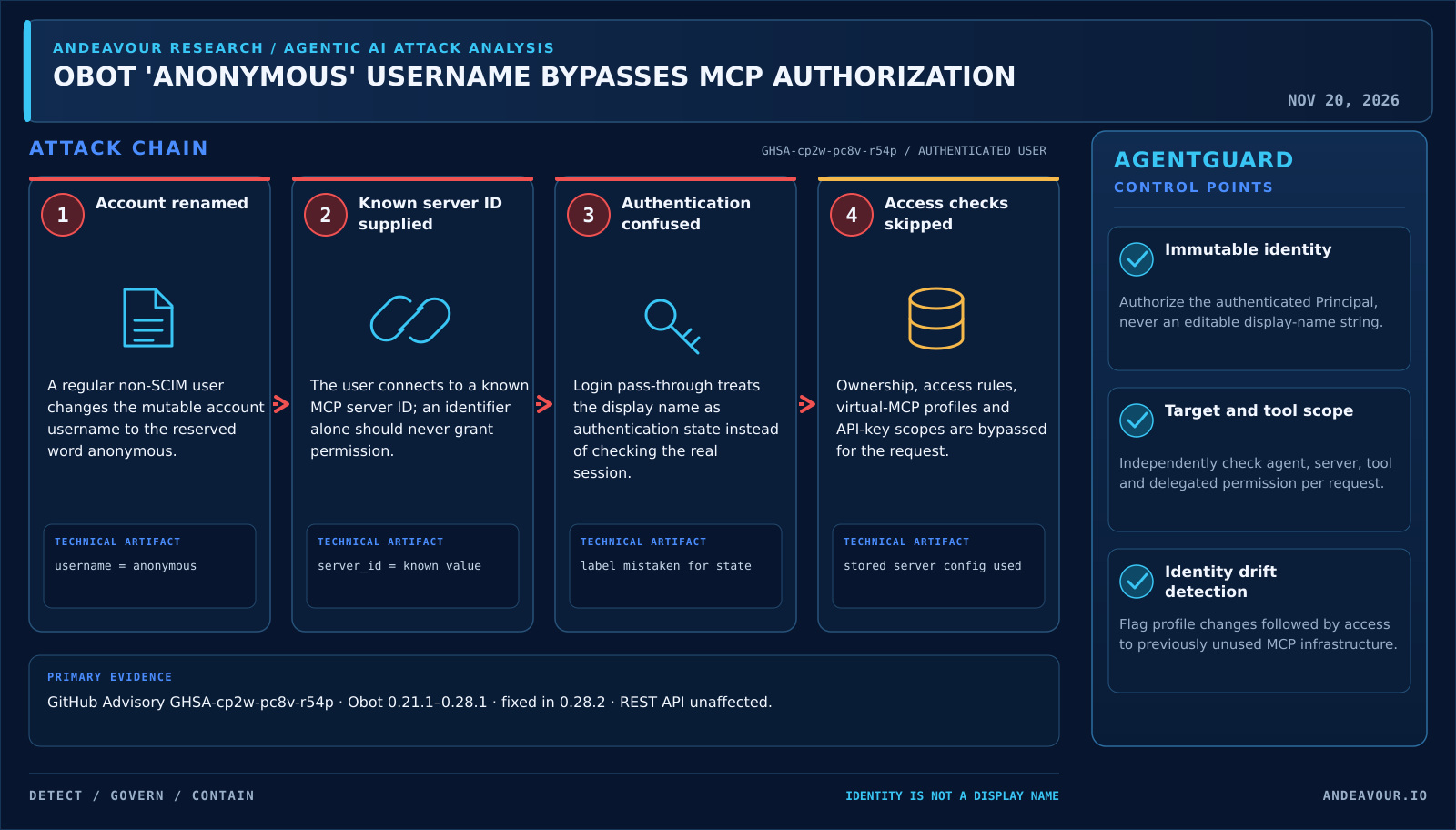
- 1
A regular non-SCIM user renames their account to anonymous
- 2
The user supplies a known MCP server ID
- 3
Login pass-through mistakes the username for authentication state
AgentGuard re-authorizes the immutable Principal, target and tool instead of accepting a display name or an upstream authorized flag
- 4
Ownership, access rules, profiles and API-key scopes are skipped
- 5
The MCP request runs with the server's stored configuration
- Affected
- Obot deployments running 0.21.1–0.28.1 with authentication enabled
- When
- Advisory published November 20, 2026
- Impact
- Unauthorized access to a known MCP server through skipped ownership, profile and API-key scope checks
What happened inside the authorization flow
The advisory describes a login pass-through that treated the username anonymous as a signal about authentication state. A regular user who was not provisioned through SCIM could set that username. When the user connected to a known MCP server ID, the request took a path intended for a different authentication condition.
That path skipped the server's ownership check, configured access-control rules, virtual-MCP profiles and API-key scopes. The request still executed as the authenticated user with the MCP server's stored configuration. In other words, this was not a password bypass; it was an authorization bypass caused by using mutable profile data as a security signal.
Version 0.28.2 fixes the issue by checking actual authentication state and removing user-controlled username changes. The boundaries of the advisory matter: unrelated server IDs are random and not automatically exposed, servers requiring per-user OAuth are not exposed through this bypass, and REST API access is unaffected.
Why agent identities must be immutable
Agent gateways routinely compose identities: the human account, the agent session, the MCP client, the server owner and upstream credentials. If any layer substitutes a display name for the authenticated principal, every later control can evaluate the wrong subject.
A secure decision needs an immutable identity and an explicit delegation chain. Who commands the agent, which agent is acting, which server is targeted and which tool is being invoked are separate facts. None should be inferred from a username string.
- Display names are labels, not authentication evidence
- A valid login does not imply access to every MCP server
- Server IDs are identifiers, not authorization capabilities
- Delegated scopes must survive every gateway pass-through
How AgentGuard would have stopped the unauthorized action
AgentGuard begins with the AI Principal and the agent identity, not with a profile label. Its policy decision binds the authenticated Principal to the agents it may command and the MCP servers and tools those agents may use. Renaming an account does not rewrite that binding.
At the moment an agent invokes a tool, AgentGuard independently evaluates the immutable identity, delegated scope, target and declared task. A request that skipped Obot's own ownership and scope checks would still encounter a separate decision: is this Principal allowed to command this agent against this server for this purpose?
The platform also makes identity drift visible. A sudden profile change followed by access to previously unused MCP infrastructure is a high-value investigation signal. This is containment and independent enforcement, not a substitute for installing Obot 0.28.2.
What to do now
Patch the gateway and then verify that authorization is consistent across every agent and MCP path.
- Upgrade affected Obot deployments to 0.28.2 or later
- Review accounts renamed to anonymous and their MCP activity
- Inventory which Principals may access each MCP server and tool
- Test authorization with known server IDs and reduced API-key scopes
The lesson
An agent's valid session does not make every action legitimate. Identity must be a stable security fact throughout the agent delegation chain, not editable presentation data. AgentGuard adds an independent control plane around agents, their Principals, their tools and their declared tasks, so a framework decision is not the only decision that matters. The advisories themselves still need to be patched or the malicious package removed.
Frequently asked questions
Did the Obot flaw allow anyone on the internet to use an MCP server?
No. The advisory describes a regular authenticated, non-SCIM-provisioned account renaming itself to anonymous and using a known MCP server ID. It does not establish general unauthenticated access or automatic discovery of every server ID.
Which Obot release fixes the anonymous authorization bypass?
Obot 0.28.2. Versions 0.21.1 through 0.28.1 with authentication enabled are affected.
How does AgentGuard prevent identity-confusion authorization bypasses?
AgentGuard independently authorizes immutable Principals and agent identities against delegated scopes, target servers, tools and declared tasks. A mutable display name cannot expand those permissions.
See AgentGuard on your own environment
Zero integration. Live in days. We'll show you what your current stack is missing.