The Approval Said '(no command)': mcp-ssh-manager Hid the Deployment an Agent Asked a Human to Approve
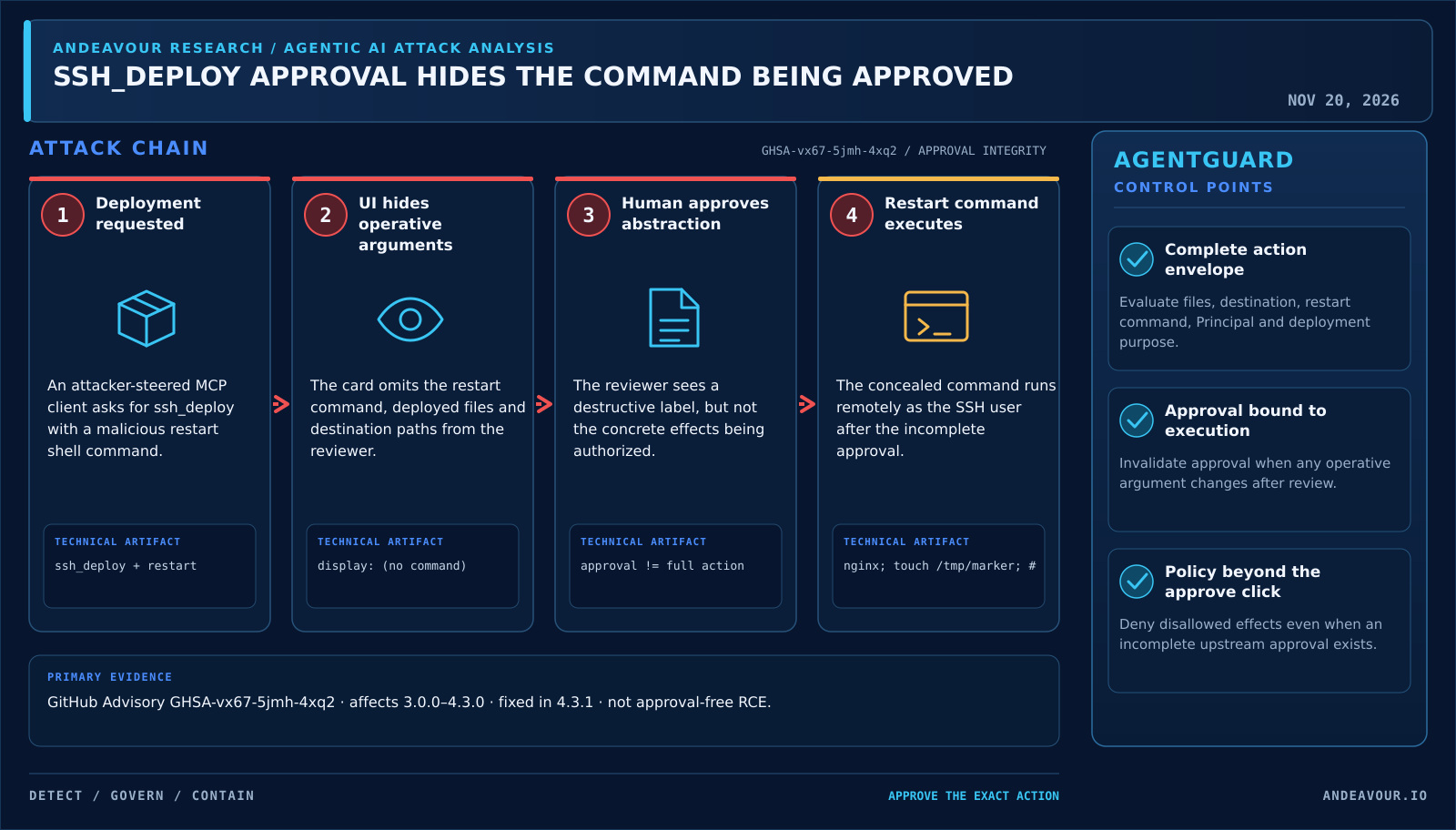
Key takeaways
- →GHSA-vx67-5jmh-4xq2 affects mcp-ssh-manager 3.0.0 through 4.3.0 when ssh_deploy approval is configured as destructive or always.
- →The approval UI showed the tool name, a destructive label and '(no command)', while omitting the restart shell command, files and destination paths. An approval could therefore authorize effects the reviewer never saw.
- →Version 4.3.1 fixes the display. AgentGuard adds action-envelope integrity: policy and approval must cover the exact command, files, destination, Principal and purpose before execution.
- 1
An attacker steers an MCP client into requesting ssh_deploy
- 2
The request contains a malicious restart shell command
- 3
The approval card omits the restart command, files and destinations
- 4
A human approves an operation whose real effects were not displayed
AgentGuard binds policy and approval to the complete action envelope and blocks effects outside the Principal's authorized deployment task
- 5
The restart command executes remotely as the SSH user
- Affected
- Operators approving ssh_deploy in mcp-ssh-manager 3.0.0–4.3.0 with destructive or always approval
- When
- Advisory published November 20, 2026
- Impact
- A reviewer could approve a remote restart command and deployment without seeing its operative arguments
What the reviewer did not see
ssh_deploy is intentionally powerful: it deploys files and can run a restart shell command over SSH. The vulnerability was not simply that restart accepts shell syntax; that is part of the tool's intended function. The vulnerability was that the approval interface concealed the arguments a reviewer needed to make an informed decision.
With approval configured as destructive or always, affected versions displayed the tool name, a Destructive label and '(no command)'. They omitted the restart value, the files being deployed and destination paths. The maintainer reproduced execution with a restart value containing nginx; touch /tmp/marker; #, demonstrating why the omitted text mattered.
Version 4.3.1 displays the relevant arguments with secrets removed. This was not approval-free remote code execution: readonly and restricted servers refuse ssh_deploy, and an unrestricted server without approval already gives the caller command execution through other tools.
Why human-in-the-loop is not automatically a safety control
An approval is only as strong as the action representation shown to the reviewer. If the UI approves a tool name while execution consumes a different, richer argument set, the human is approving an abstraction rather than the operation.
Agents increase the speed and complexity of this problem. They can assemble deployment parameters from many inputs, including untrusted content. A reviewer needs a stable, complete and minimally redacted representation of effects, not a generic warning that something destructive might happen.
- The approved object must be the executed object
- Secrets should be redacted without hiding operational effects
- Files, destinations and restart commands are security-relevant arguments
- A destructive label alone does not provide meaningful review
How AgentGuard would make approval meaningful
AgentGuard treats a privileged agent operation as a complete action envelope: immutable Principal, agent identity, declared task, target, files, destination and command. Policy evaluates that envelope before the operation, not just the MCP method name.
The approval record must be bound to the same canonical envelope that execution receives. If a restart command, file list or destination changes after review, the approval no longer matches and the action is denied or requires fresh review. Disallowed effects are blocked even when a user clicks approve.
This does not repair the vulnerable mcp-ssh-manager UI; upgrading to 4.3.1 does. AgentGuard supplies the independent policy and audit boundary that ensures a generic upstream approval cannot expand the agent's authority beyond its registered deployment task.
What to do now
Update the tool and review recent approvals as potentially lacking the information needed for informed consent.
- Upgrade mcp-ssh-manager to 4.3.1 or later
- Review ssh_deploy approvals on versions 3.0.0–4.3.0
- Bind approvals to exact files, destinations and restart commands
- Invalidate approval whenever any operative argument changes
The lesson
An agent's valid session does not make every action legitimate. Human review works only when policy, presentation and execution all refer to exactly the same action. AgentGuard adds an independent control plane around agents, their Principals, their tools and their declared tasks, so a framework decision is not the only decision that matters. The advisories themselves still need to be patched or the malicious package removed.
Frequently asked questions
What did the vulnerable ssh_deploy approval card hide?
It omitted the restart shell command, files being deployed and destination paths. It showed the tool name, a destructive label and '(no command)' instead.
Was ssh_deploy remote code execution possible without approval?
That is not the advisory's claim. The issue concerns configurations requiring destructive or always approval. Readonly and restricted servers refuse ssh_deploy; unrestricted servers without approval already expose command execution through other tools.
How would AgentGuard improve agent deployment approvals?
AgentGuard evaluates and binds approval to the full action envelope, including Principal, task, target, files, destination and command. Any material change invalidates the approval, and policy can deny effects even when a reviewer approves.
See AgentGuard on your own environment
Zero integration. Live in days. We'll show you what your current stack is missing.