Attacker AI Agents Hunting AI Apps: Inside the ARTEX Campaign Against LiteLLM, Dify and One API
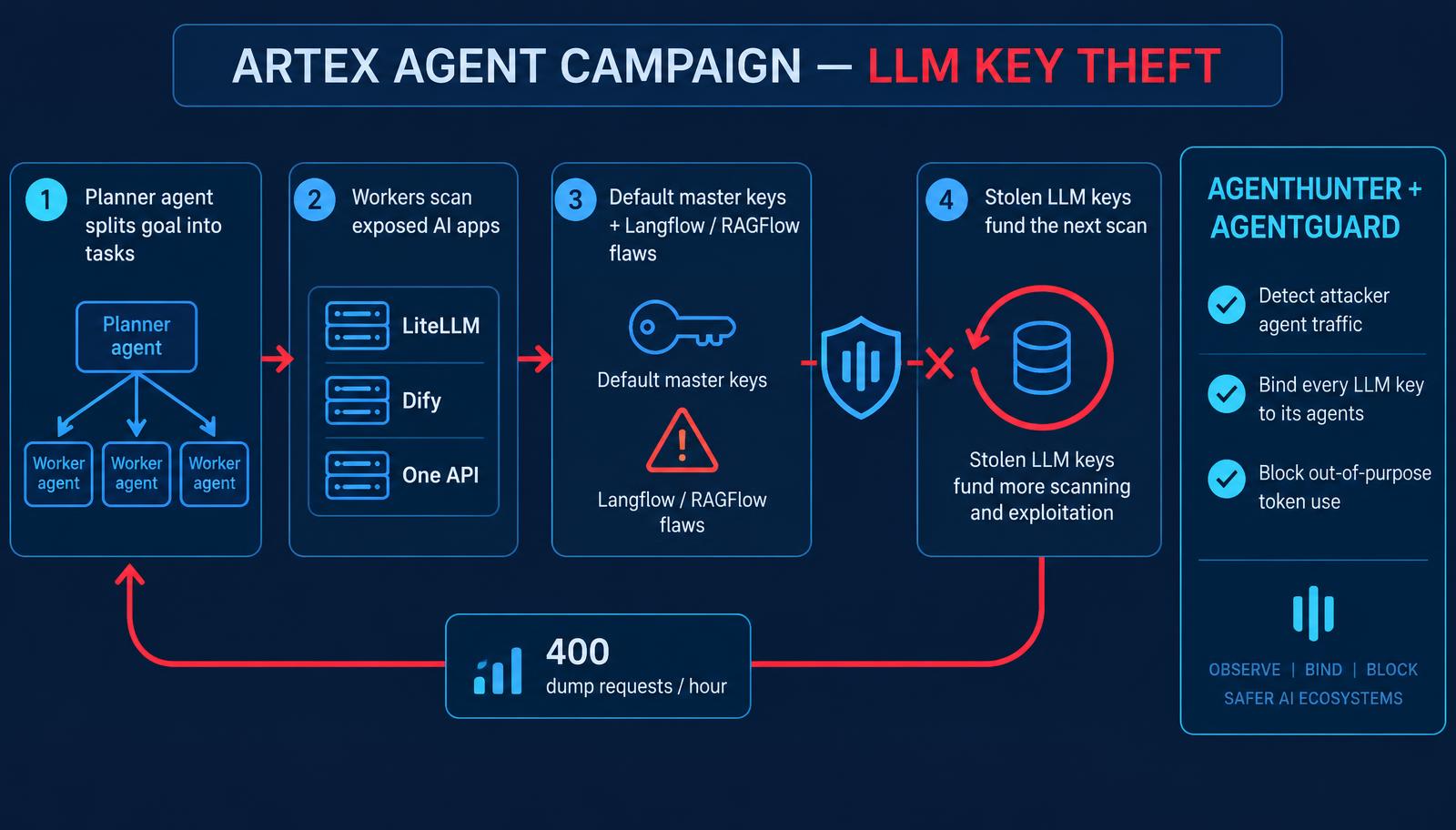
Key takeaways
- →Amazon's threat intelligence team used MadPot decoys posing as LLM services to capture attacker AI agents hunting internet-exposed AI apps such as LiteLLM, One API and Dify for stored provider keys, from October 3 into November 2026.
- →The agents' own records included a per-product playbook: default admin credentials like LiteLLM's default master key, unfinished installs, and known Langflow and RAGFlow flaws. Amazon assesses with moderate confidence they ran on ARTEX, an open-source AI pentesting tool.
- →Google's GTIG reported the same week that threat actors are running multi-agent offensive frameworks at machine speed. AgentHunter detects attacker agents hitting your AI apps; AgentGuard makes sure a stolen key or token can't be turned into out-of-purpose actions.
- 1
Operator gives ARTEX a target and a goal
- 2
Planner agent assigns scanning tasks to worker agents
- 3
Agents try default master keys and known Langflow/RAGFlow flaws
AgentHunter identifies the attacking agents; AgentGuard blocks stolen keys from out-of-purpose use
- 4
Stored LLM provider keys are extracted
- 5
Stolen keys power the models that hunt for more keys
- Affected
- Internet-exposed AI gateways and LLM apps (LiteLLM, One API, Dify and others)
- When
- Decoy captures October 3 to mid-November 2026 · reported November 16, 2026
- Impact
- Theft of AI provider API keys, reused to fund further attacks; CI/CD token abuse
What Amazon found
Amazon runs a decoy network called MadPot. Some of its servers pose as popular LLM services. From October 3, 2026 into November, attacker AI agents sent those decoys their requests, and because agents send their work to an LLM to decide the next step, those requests often carried the campaign's full history: the operator's instructions and the agents' reported findings.
Those records show agents hunting for weak spots in internet-exposed AI apps such as LiteLLM, One API and Dify to steal the AI provider keys stored inside. They describe stolen keys being used to run the very models that powered the search for more keys. Amazon says it can't verify the outcomes the agents reported, and has moderate confidence the agents ran on ARTEX, an open-source AI pentesting tool.
The playbook was mundane and effective: default administrator credentials such as LiteLLM's default master key, unfinished installs an outsider could take over, and known flaws in Langflow and RAGFlow. In a separate case, Cloudflare's responders saw ARTEX reach a compromised CI/CD API token with no IP restrictions or rate limiting, followed by 400 database dump requests in an hour.
Why this is a turning point
The same week, Google Threat Intelligence Group reported threat actors running autonomous multi-agent offensive frameworks, including ARTEX, CAIRN, CyberStrikeAI and PentAGI, and using LLMs to reverse-engineer patches into exploits. Attacks now run at machine speed, and AI infrastructure itself is the prize.
- A planner agent splits the goal; worker agents run the tools
- Default credentials on AI gateways are found in minutes, not weeks
- Each stolen LLM key funds the next round of the campaign
- A token without IP limits becomes a data-dump pipeline
How AgentGuard and AgentHunter would have stopped it
AgentHunter is built to tell AI agents from humans and ordinary bots. ARTEX-style traffic has an agent's fingerprint: planner-worker fan-out, tool-driven probing, and rapid adaptation between attempts. AgentHunter flags it hitting your AI gateways and admin panels at step three, before the default-credential and known-flaw checks land.
AgentGuard handles what happens if something gets through. It inventories every LLM key, AI gateway and agent token and binds each to the agents and Principals allowed to use it. A provider key suddenly driving an unknown agent, or a CI token issuing 400 dump requests an hour, falls outside every registered purpose and is blocked, not just logged.
Together they cut both halves of the loop: attacker agents can't easily find and loot your AI stack, and loot that leaks can't be quietly turned into new actions.
What to do Monday
Assume attacker agents have already scanned your AI apps.
- Change default master keys on LiteLLM and admin credentials on Dify and One API
- Patch Langflow and RAGFlow, and take unfinished installs offline
- Put IP restrictions and rate limits on CI/CD and AI gateway tokens
- Inventory every LLM provider key and which agents may use it
The lesson
Each of these incidents turned an AI agent, or the tooling around it, into the attacker's best employee: legitimate credentials, legitimate permissions, machine speed. Patching the one flaw doesn't change that. AgentGuard and AgentHunter governs what every agent and its Principal is allowed to do, wherever it runs, with zero integration and deployment measured in days.
Frequently asked questions
What did Amazon's MadPot capture?
Decoy servers posing as LLM services captured requests from attacker AI agents between October 3 and mid-November 2026, including operator instructions and findings, showing a campaign to steal AI provider keys from exposed LiteLLM, One API and Dify apps.
What is ARTEX?
ARTEX is an open-source AI penetration-testing framework in which a planner agent splits a goal into tasks for worker agents that run security tools. Amazon has moderate confidence the captured campaign ran on it, and Google reported threat actors using it.
How do AgentHunter and AgentGuard defend against attacker AI agents?
AgentHunter detects AI agent traffic probing your apps and gateways. AgentGuard binds every LLM key and agent token to its allowed agents and purpose, blocking stolen credentials from being used for anything else.
See AgentGuard + AgentHunter on your own environment
Zero integration. Live in days. We'll show you what your current stack is missing.